
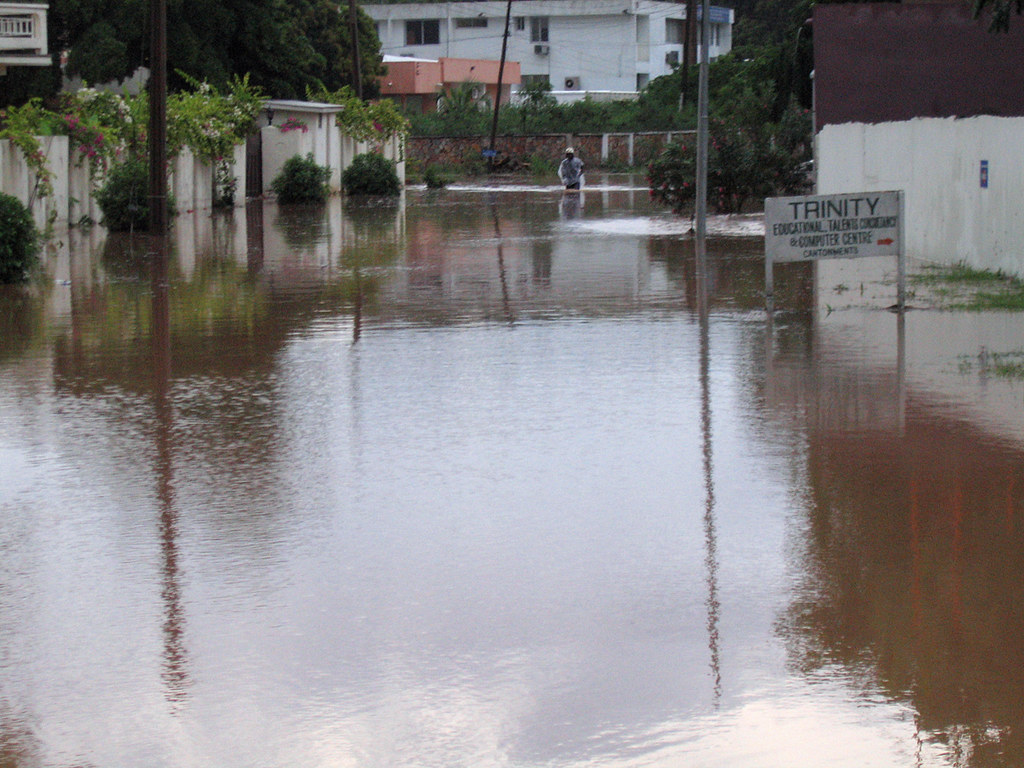

Kenya’s 2026 floods displaced more than 18,500 households and left thousands still living in camps months after the rains stopped. The Kenya Red Cross Society (KRCS) is running the largest shelter response, working with county governments to operate 66 camps, but NGOs including smaller CBOs are increasingly the ones filling the gap between an emergency tent and a family’s next real home. With the October-December short rains now forecast, the sector’s shelter work is shifting from cleanup to preparedness.
How bad were Kenya’s 2026 floods, exactly?
Flash flooding began on the night of 6-7 March 2026, when the Nairobi River burst its banks after heavy overnight rain, sweeping away vehicles and cutting off Mombasa Road and Uhuru Highway. The flooding continued in waves through late May, eventually affecting 30 counties nationwide, from Nairobi and Kiambu to Kisumu, Migori, Kwale and Mombasa. The national death toll climbed past 100 as the rains persisted, and the Kenya Defence Forces deployed a rescue unit alongside the Kenya Red Cross to reach cut-off communities.
By May, KRCS had tracked the damage across 41 counties. Its own numbers, published on its Floods 2026 response page, are the clearest public picture of the housing impact:
- Households affected nationally: over 85,000
- People displaced: more than 18,587
- Displacement camps established: 66, run jointly with county governments
- Hardest-hit inland counties: Homa Bay, Kisumu and Migori
- Coastal households affected (6 counties): roughly 23,060, with 4,902 people displaced
- Early-warning SMS alerts sent: over 26 million
Relief distribution has reached 6,319 households with shelter non-food items such as tarpaulins and tents, alongside food assistance for 6,172 households and WASH kits for 4,403 more — the kind of integrated response our WASH NGOs in Kenya guide covers in more depth.
Who is actually providing shelter right now?
KRCS’s camp model is the backbone of the emergency response: tents and communal shelter set up on county land, run with local administration, and supplied through the national Red Cross logistics chain. That structure is why 66 camps could go up quickly across such a wide geographic spread, but a canvas tent shared by an extended family is not a housing solution — it’s a holding pattern.
That’s the gap most NGO shelter work is now trying to close: moving households from a communal camp into something they can call their own again, even temporarily, while permanent rebuilding is arranged. For county-level CBOs, this usually means partnering directly with the camp administration to identify the most vulnerable households first — female-headed families, people with disabilities, and households whose homes were built on now-unstable riparian land that shouldn’t be rebuilt on at all. Displacement itself carries a mental health toll worth planning for too, something our post-disaster counseling guide lays out in detail.
Why is riparian land such a recurring problem?
Kenya’s flood damage keeps concentrating in the same kinds of places: informal settlements and low-income housing built along riverbanks and floodplains in Nairobi and other fast-growing towns. Weak enforcement of land-use rules and drainage systems that haven’t kept pace with urban growth mean the same neighbourhoods flood repeatedly. For NGOs doing shelter or resettlement work, this raises a harder question than “how do we rebuild this house” — it’s whether rebuilding on the same plot just resets the clock until the next heavy rains.
What should NGOs be doing before the short rains hit?
Kenya’s October-December short rains are the next real test, and the sector doesn’t have much runway. As covered in our El Niño 2026 preparedness guide, KRCS has already warned that up to 2 million people across 46 of Kenya’s 47 counties could be affected by the coming short rains, and the new National Disaster Risk Management Act now formally routes disaster coordination through county disaster committees rather than ad hoc arrangements.
For shelter-focused organisations specifically, that means three practical priorities this quarter: pre-positioning shelter NFIs (tarpaulins, ropes, timber) in the counties KRCS has already flagged as high-risk rather than waiting for a new appeal; registering with the relevant county disaster committee now so aid isn’t held up by coordination gaps when the rains start; and building relocation options for households still on unstable riparian land into any shelter programme, not just repair kits for homes in the same flood-prone spot.
Frequently asked questions
How many people are still displaced by Kenya’s 2026 floods?
KRCS’s own tracking, current as of May 2026, put the number at more than 18,587 people displaced nationally, with over 85,000 households affected across 41 counties. Coastal counties added a further 4,902 displaced people on top of that.
Which organisation is running most of the flood shelter camps?
The Kenya Red Cross Society, in partnership with county governments, established and continues to run the 66 camps that make up the bulk of Kenya’s formal flood-displacement shelter response.
What’s the difference between emergency shelter and transitional shelter?
Emergency shelter is the tent or communal camp space a family gets immediately after a disaster. Transitional shelter is a more durable, semi-permanent structure — built from materials like timber, mabati or bricks — that a household can live in for months or years while a permanent home is rebuilt or resettlement is arranged.
Why do the same Kenyan neighbourhoods keep flooding?
Much of the damage concentrates in informal settlements built on riparian land and floodplains, where drainage infrastructure hasn’t kept pace with rapid urban growth and land-use rules are weakly enforced — so the same low-lying areas flood in nearly every heavy rains season.
How can a small CBO get involved in flood shelter response?
The most direct route is registering with the county disaster committee under the National Disaster Risk Management Act, which is now the formal coordination point NGOs and CBOs are expected to work through, rather than approaching camps independently.
By the NGOs.ke Editorial Team


Leave your comment