

By the NGOs.ke Editorial Team
Rainwater harvesting in Kenya has rarely had a better window than right now. The Kenya Meteorological Department’s October–December 2026 outlook expects above-average rainfall across most of the country, boosted by an El Niño it describes as “currently strong”, and its water-sector advisory explicitly calls for enhanced rainwater harvesting to supplement supplies. For NGOs running WASH, school or community programmes, that means the next few weeks are a chance to capture water that will matter in the dry months of 2027, as long as the systems are sized, built and managed properly.
This guide, updated in November 2026, covers where the rains are expected, how to size a tank from a roof, what tanks cost, and what makes school and community rainwater projects last.
Why does the 2026 El Niño matter for rainwater harvesting?
The Met Department’s OND 2026 seasonal forecast (issued 31 August 2026) lists above-average rainfall for more than 40 counties, from Nairobi, Kiambu and the central highlands to the Lake Basin, the coast and much of the north-east, including Garissa, Wajir and Mandera. Only Turkana and parts of West Pokot, Samburu and Marsabit are forecast near-average to above-average. No county is forecast below normal.
That is unusual for arid and semi-arid counties that normally get thin, erratic short rains. It’s also exactly where stored water is most valuable once the rains stop. In the forecast’s own timing table, the north-eastern and coastal counties are expected to see rains end around the first to second week of December, while many western and central counties run into January. Roof catchment that isn’t connected to storage before cessation is water lost until the 2027 long rains.
There’s a flip side. The same advisory flags flood risk to water infrastructure and calls for desilting of dams and pans. Harvesting projects in flood-prone sites need overflow routing and secure tank bases, not just more litres.
Key facts at a glance
| Item | Detail (as of November 2026) |
|---|---|
| Season outlook | Above-average OND rainfall in 40+ counties (KMD, issued 31 Aug 2026) |
| Driver | El Niño described by KMD as “currently strong”, alongside a positive Indian Ocean Dipole |
| Earliest cessation | North-east and coast: around 1st–2nd week of December |
| Official advisory | “Enhancing rainwater harvesting initiatives to supplement water supplies” |
| Rule of thumb | 1 mm of rain on 1 m² of roof = 1 litre before losses |
| Example tank price | Roto 1,000 L vertical tank: KSh 16,020 retail incl. VAT (price list effective 15 June 2026) |
How much water can a roof actually collect?
The arithmetic is simple, and it’s the step most small projects skip. Every millimetre of rain falling on one square metre of roof gives one litre of water. You then lose some to evaporation, splash, first-flush diversion and leaky gutters, so planners typically apply a runoff factor of around 0.8 for iron-sheet roofs.
Take a classroom block with 100 m² of iron roof in a county expecting 300 mm over the season:
- 100 m² × 300 mm = 30,000 litres falling on the roof
- × 0.8 runoff factor = roughly 24,000 litres you could realistically store
- A single 5,000-litre tank would fill and overflow several times; you’d need closer to 20,000–25,000 litres of storage to keep it all
Swap in your county’s expected totals from the Met Department and real roof measurements. The point is to match storage to catchment, not to the budget line someone wrote months ago. Under-sized tanks overflowing in December are a common, and entirely avoidable, failure.
What do rainwater tanks cost in Kenya in 2026?
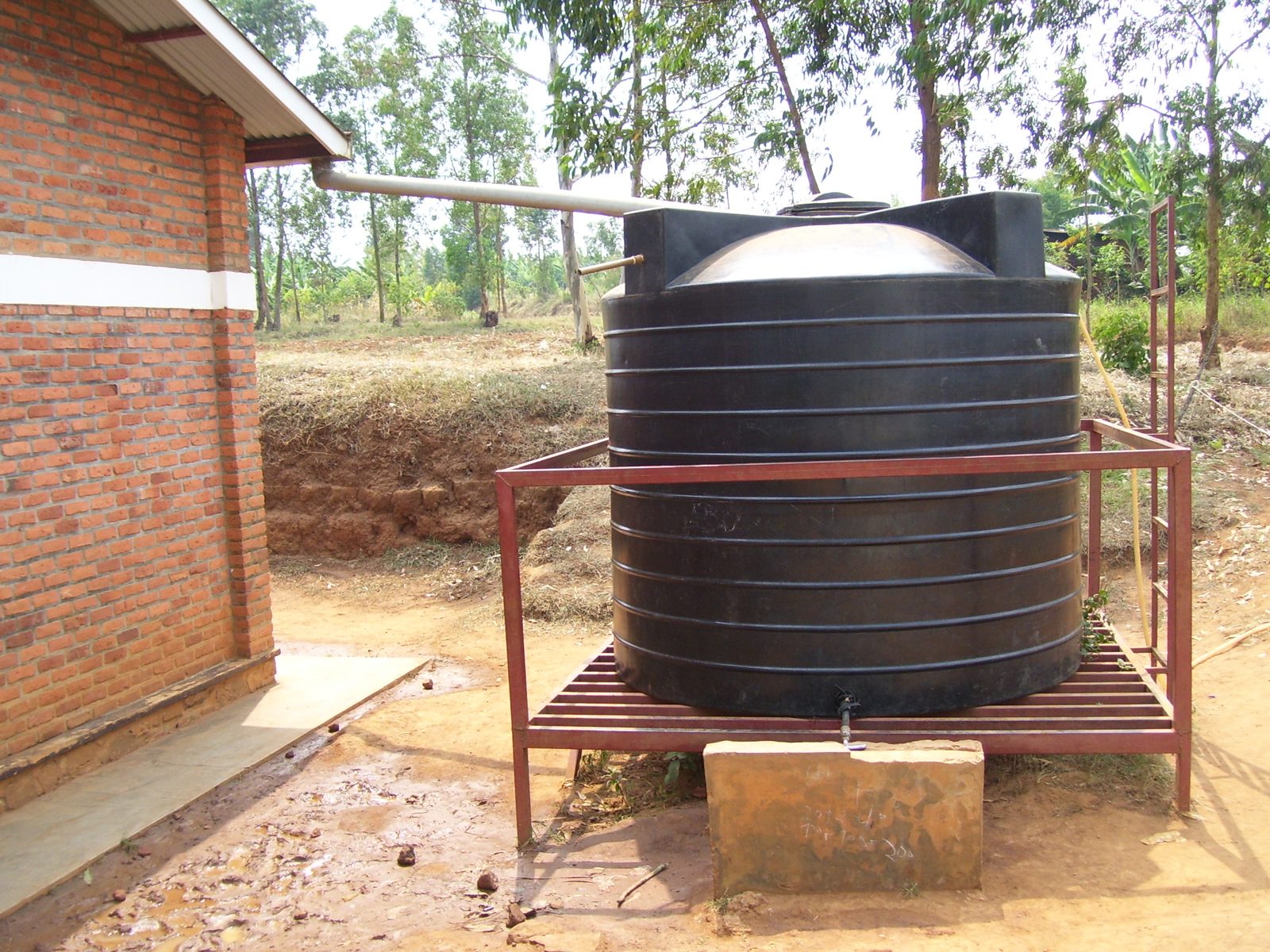
Plastic tanks are still the default for households and small institutions. Roto Moulders’ price list effective 15 June 2026 put a 1,000-litre vertical water tank at KSh 16,020 retail including 16% VAT, with discounted columns for bulk and institutional buyers. Larger tanks scale up steeply, so always get a written quote for the exact size and confirm whether VAT and delivery are included.
For large volumes, masonry or ferro-cement tanks built on site often work out cheaper per litre and last longer. The Water Project’s planned rainwater system at Nzuli Secondary School in south-eastern Kenya is a 104,000-litre masonry tank for a school of 305 students and 25 staff, a school that currently spends about KSh 21,000 a month buying piped water.
Budget lines people forget:
- Gutters, downpipes and fascia boards (often the weakest link on older school roofs)
- First-flush diverters and mesh screens to keep debris and bird droppings out
- A raised, level base: concrete for plastic tanks, proper foundations for masonry
- Taps, a lockable outlet and a soak-away to stop mud and stagnant water
- Training and a small annual maintenance fund
What does a good community rainwater project look like?
On Pate Island in Lamu, where groundwater is too salty to drink, the Northern Rangelands Trust and the Pate Community Conservancy have rolled out underground rainwater tanks (known locally as djabias) plus concrete and plastic tanks with DANIDA funding. According to NRT’s September 2026 update, Shanga Comprehensive School, with 237 students, estimates the project has solved about 90% of its water problems. Before it, 20 litres could cost KSh 100; the school now sells harvested water to the community at KSh 20 for 20 litres, and some households have around 200 litres a day available.
A few lessons travel well from projects like this:
- Pick the right structure for the site. Underground or partly buried tanks keep water cool and suit places with space and no flood risk; plastic tanks are faster to deploy before cessation.
- Plan the money side. A small charge per jerrican, agreed with the community, can fund repairs and cleaning.
- Give someone ownership. School health clubs and water user committees, named and trained, keep gutters clean and taps fixed.
- Treat before drinking. Roof water is generally good for washing and cleaning, but drinking water needs boiling, chlorination or filtration.
What should NGOs do before the rains end?
- Audit existing tanks now. Many schools and health facilities already have tanks that aren’t connected, have broken gutters, or have cracked bases. Fixing these is the fastest win.
- Prioritise north-eastern and coastal sites where cessation is expected earliest in December.
- Coordinate with county water departments to avoid duplicating government-funded tanks and dams.
- Build in flood safety. Route overflow away from foundations and latrines, and avoid low-lying sites.
- Pair tanks with hygiene. A tank next to a handwashing station delivers far more health value than one locked in a store.
- Document results. Record litres stored, months of supply and cost savings; donors fund what they can measure.
If your organisation is also responding to flooding or food insecurity this season, see our Short Rains 2026 county outlook for NGO planning, the El Niño health and food security checklist, and our handwashing planning guide. The full county-by-county forecast is available from the Kenya Meteorological Department.
Frequently asked questions
Is rainwater harvesting legal in Kenya?
Yes. Collecting rain from your own roof for domestic and institutional use is encouraged, and the Met Department’s 2026 seasonal advisory specifically recommends it. Large dams or abstractions from rivers fall under separate water permits.
How big a tank does a school need?
Multiply roof area (m²) by expected seasonal rainfall (mm) and by about 0.8 to estimate litres you can capture, then check it against daily demand (pupils × litres per day) over the dry months. Most schools are under-stored rather than under-roofed.
Is harvested rainwater safe to drink?
Not automatically. Use first-flush diverters, clean gutters and covered tanks, and boil, chlorinate or filter water before drinking.
Which counties benefit most from the 2026 short rains?
KMD expects above-average rainfall in more than 40 counties, including ASAL counties such as Garissa, Wajir, Mandera, Isiolo, Kitui and Makueni, where storing water for the dry season makes the biggest difference.
Plastic or masonry tanks?
Plastic tanks are quick to install and suit volumes up to about 10,000 litres. For tens of thousands of litres, masonry or ferro-cement tanks built on site are usually cheaper per litre and more durable.
Also worth a read: Kenya Short Rains 2026: When El Niño Rains Start by Region — from 254.ke, part of the NGO Summit media network.


Very well written and clear explanation, thanks.
Kelsey
November 14, 2026